
Commercial Kitchen Equipment Selection for High-Volume Buffet Lines
Why Throughput, Temperature, and Layout Decide Success
During a buffet’s lunch and dinner rushes, food has to be cooked, replenished, and held at safe temperatures while guests keep moving past the line. For operators working from the Hibachi Grill & Supreme Buffet Las Vegas menu, that rhythm sets the equipment plan: how many fryers, how many steam tables, how long the hot line runs.
The goal is not the largest unit on the floor but capacity matched to actual traffic. A buffet line in near-constant use needs equipment that recovers heat fast, tolerates daily abuse, and sits in a layout guests can walk without bunching up.
If throughput falls behind, holding temperatures drift, or stations sit too far apart, food quality drops and the line slows. An empty tray, or one that has cooled below the safe range, costs both sales and reputation. That is why equipment gets decided early in buffet planning rather than tacked on at the end.
Understanding the Demands of High-Volume Buffet Lines
At peak, one service window can move hundreds of guests in close succession, and the equipment behind the line has to absorb that without faltering. A single undersized well, or a slow recovery time, shows up across the whole service.
Four pressures shape the line:
- Peak-hour traffic pushes stations hard, so warming wells, carving stations, and holding cabinets need to be sized for the busiest hour, not the average one.
- Continuous replenishment empties and refills hotel pans dozens of times per shift, so modular, stackable, quick-swap formats pay off.
- Temperature retention is not optional; food held outside safe thresholds threatens both quality and compliance, which makes reliable thermostatic controls worth more than a sleek finish.
- Menu variety multiplies the load: sushi, hibachi, fried items, and desserts each need their own holding and display.
These forces shape high-volume buffet operations long before the first plate goes out. Operators who plan around real traffic rather than an ideal average end up buying components that recover quickly, clean easily, and stay presentable all service. That is the difference between a line that holds up and one that buckles at 7 p.m. on a Saturday.
Holding and Heating Equipment for Buffet Lines
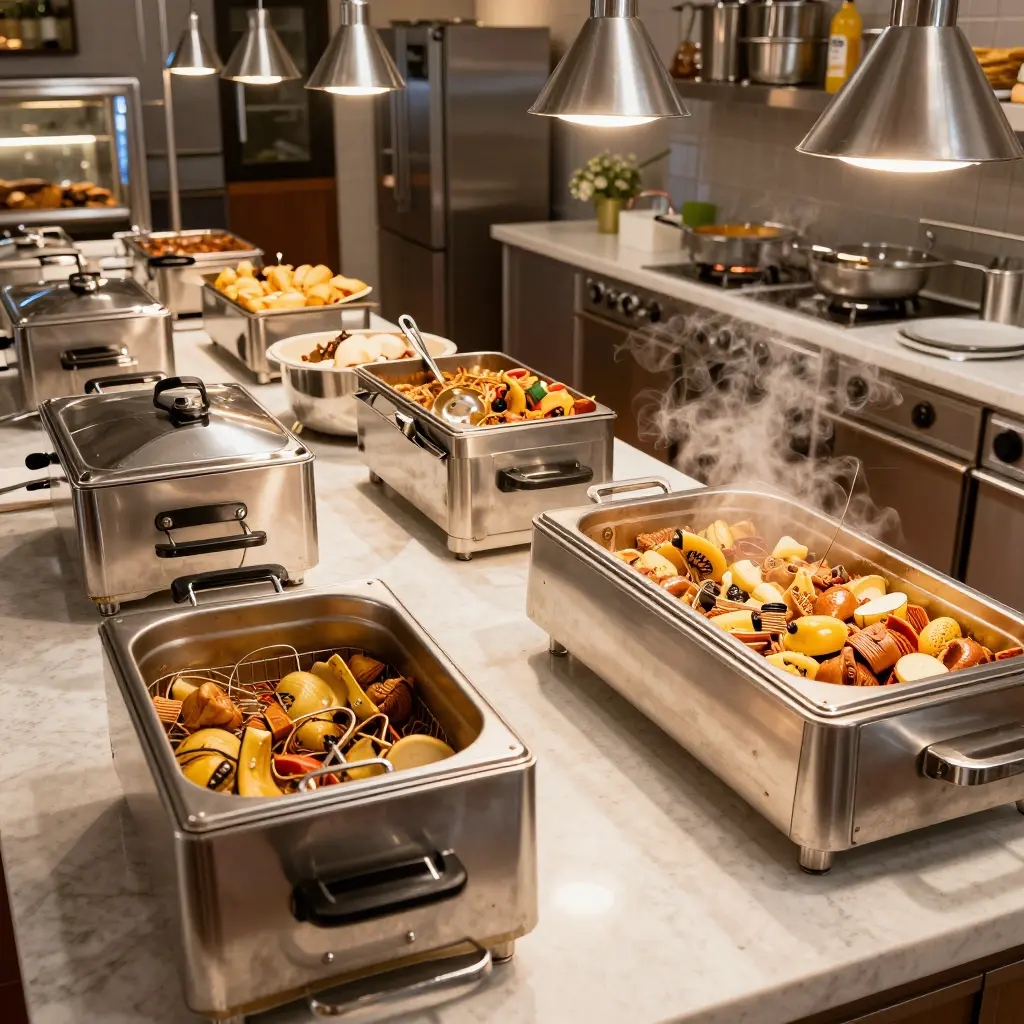
Holding equipment keeps food at safe, appetizing temperatures from the first guest to the last. The main categories are steam tables, heat lamps, holding cabinets, soup warmers, and chafing systems, and each one affects moisture, texture, and color over a long service.
Steam tables and soup warmers add moisture by design. They hold wet foods such as sauces, soups, and stewed dishes in water baths typically between 165°F and 200°F. Heat lamps warm fried items, grilled meats, and starches without adding moisture, while chafing dishes use a water bath under the food pan to hold heat gently. Holding cabinets sit between the two, keeping large batches hot and humid before they reach the line.
Moisture is the hard part. Too much steam turns fried food soggy; too little dries out rice and roasted meats. Covering pans partially and checking humidity through the shift helps. Temperature matters just as much: hot holding stays at or above 135°F, and cold items need 41°F or below to keep pathogens from growing.
Recovery time is how quickly a unit returns to its target temperature after a pan is swapped or a crowd hits. Fast recovery is what protects food quality at peak. Choosing commercial kitchen equipment with strong recovery ratings keeps results consistent, as in the setup behind the Las Vegas buffet menu, and keeps the buffet line stocked through the rush.
Selecting Equipment for Live Hibachi Stations
Start with the griddle. A commercial teppanyaki plate 3/4 to 1 inch thick in cold-rolled or stainless-clad steel, four to six feet wide with two or three independent heat zones, is the usual specification. Each zone should deliver 30,000 to 40,000 BTU and hold 400 to 450 degrees Fahrenheit across the surface at peak. A raised front lip and recessed corners keep food on the plate during fast tossing.
Ventilation decides whether the station runs legally and comfortably. A Type I hood has to span the full griddle plus six inches on each open side, delivering 300 to 600 CFM per linear foot, with stainless-steel baffle filters and a listed grease-duct system. Balanced make-up air is not optional: without it, smoke drifts into the dining room and hood capture falls apart.
Gas or induction comes down to workload. Gas burners supply 30,000 to 60,000 BTU for fast searing and the flame guests expect to see. Induction griddles hold temperature more precisely and run cooler with lower exhaust loads, but they need reliable 208 to 480-volt power. Many operators pair a gas show griddle with induction warming plates.
Grease management gets skipped, and it shouldn’t be. Fit a sloped grease trough, a removable drip pan, and an accessible two-inch drain, then clean baffles and troughs after every shift. Stainless baffles rated for continuous duty trap airborne grease before it reaches the ductwork, which cuts fire risk. The same standards apply to any Hibachi Grill & Supreme Buffet Las Vegas menu a planner reviews nationwide, which is what repeat operators count on.
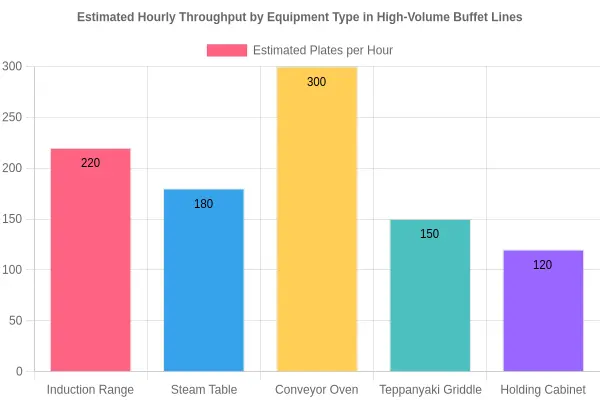
Estimated Hourly Throughput by Equipment Type in High-Volume Buffet Lines – Comparing plates or servings produced per hour across induction ranges, steam tables, conveyor ovens, teppanyaki griddles, and holding cabinets.
Data like this helps match each station’s equipment to actual guest demand, so high-traffic items such as grilled hibachi favorites and hot entrees don’t run out while slower stations avoid capital they don’t need. A conveyor oven pushing roughly 300 plates per hour can anchor a high-volume hot line; a holding cabinet at about 120 plates works better as a support unit than as a primary production source. Pair those figures with your real peak-hour covers – and review your Hibachi Grill & Supreme Buffet Las Vegas menu to identify the busiest dishes – and you can buy the right mix of cooking and holding equipment.
The wrong equipment choice shows up nightly as cold food, long queues, or high utility bills. Before buying, weigh these criteria against your own operation:
- Throughput capacity – how many covers per hour can the unit realistically support at peak?
- Footprint – does it fit the available floor space without choking traffic along the buffet line equipment?
- Energy efficiency – will operating cost stay manageable across years of daily use?
- Cleaning requirements – how quickly can staff break it down between services?
- Temperature recovery – how fast does it return to safe holding temperature after a rush?
- Maintenance availability – are parts and certified technicians easy to source locally?
- Durability – will stainless steel construction survive constant heat and humidity?
Rank them against your actual menu and traffic, not the showroom spec sheet. For an example of how equipment choices shape a menu, look at the Las Vegas menu, where high-volume stations need equipment that holds up under relentless service.
Refrigeration and Cold Display Equipment
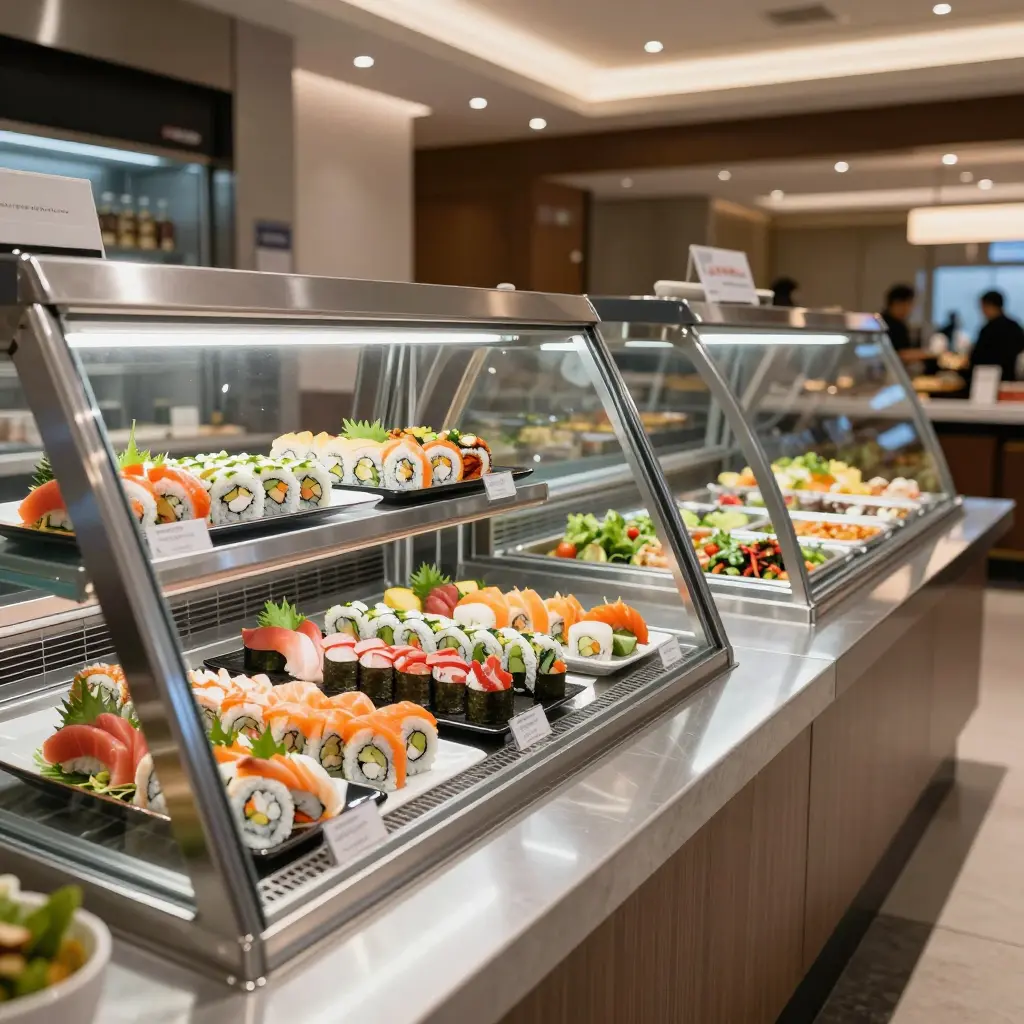
Cold holding decides how smoothly the line runs. Every refrigerated display case, sushi display unit, and salad bar has to hold food at 41°F (5°C) or below. Blast chillers do the same job upstream, cooling cooked items from 135°F to 41°F within 90 minutes before they ever reach the line.
Airflow counts as much as temperature. Cold displays need unobstructed vents and even circulation; overloading a case or stacking trays too high leaves warm pockets where bacteria grow. Leave clearance around fans and rotate product so the oldest items sit nearest the coldest zone.
Sushi display units usually pair a chilled top rail with an under-counter refrigerator, holding raw fish at 41°F or lower while showing it off. Salad bars use sneeze guards and individual cold pans. Blast chillers and rapid-cool systems exist for a reason and shouldn’t be bypassed. Each type of cold display serves its own role in sushi display standards.
Cooling capacity shapes replenishment cycles. A unit that recovers quickly re-chills after each serving wave, so staff can restock in larger batches less often. Undersized equipment means frequent small refills and temperature spikes when it gets busy. For commercial kitchen equipment buyers planning high-volume buffet lines, matching capacity to peak traffic keeps sushi, salads, and desserts safe and fresh.
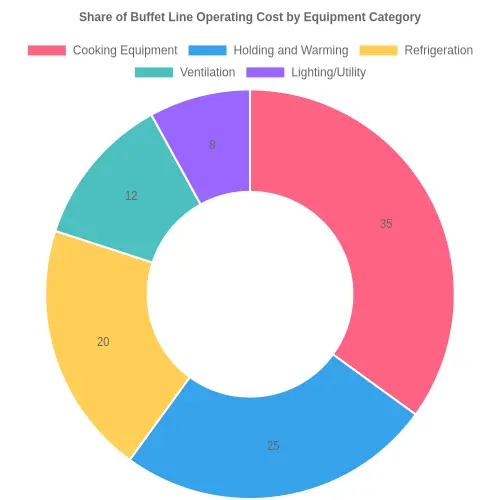
Share of Buffet Line Operating Cost by Equipment Category. Because cooking and holding equipment together drive roughly 60% of ongoing operating costs, budgeting for commercial kitchen equipment should prioritize energy-efficient models in these categories while right-sizing refrigeration, ventilation, and lighting to avoid overspending on lower-impact systems.
Maintenance and Cleaning for High-Volume Commercial Kitchen Equipment
Clean commercial kitchen equipment on a fixed schedule, not by feel. In high-volume service shortcuts catch up fast, so build routines that repeat daily, weekly, and monthly.
Start each shift by wiping and sanitizing contact surfaces, restocking, and logging holding temperatures. Assign clear ownership, post checklists, and audit results monthly.
Scheduled deep cleaning
Schedule weekly deep cleaning for the entire buffet line. Degrease hoods, grills, and fryers, and disassemble sneeze guards, warming wells, and trays.
Grease trap servicing
Service grease traps monthly, or sooner when frying loads are heavy. Keep detailed service records for health inspections.
Filter replacement
Replace hood and water filters on the manufacturer’s interval. Clogged filters raise energy costs and create fire risk.
Calibration of temperature controls
Calibrate temperature controls and probes quarterly so hot and cold items remain safe. Record every reading.
Downtime planning
Plan downtime deliberately. Schedule service during off-peak hours, stock spare parts, and stagger units so a single failure never shuts down the whole buffet line.
Train staff to report leaks, odd noises, and temperature drift right away, and document every completed task. Well-kept commercial kitchen equipment also holds its value longer, so treat these routines as an investment rather than a chore.
Frequently Asked Questions: Equipment for High-Volume Buffet Lines
How much throughput should each station handle?
Aim for 60 to 90 covers per station each hour during peak service. Fewer than 60 leaves equipment idle; more than 90 empties serving pans faster than staff can refill them.
Is gas or induction better for high-volume cooking?
Gas delivers fast recovery for hibachi grills and woks, which matters in batch cooking. Induction heats up faster and lowers the ventilation load. If local code restricts gas lines, though, induction becomes the practical default for large buffet lines.
How many holding cabinets do I need?
Budget one cabinet per four to six hot items, plus a spare. High-volume lines typically run three to five units to stage backups during rush periods.
How can I reduce energy costs?
Preheat only 30 minutes before service, keep pans covered, and shut down idle wells in low-traffic sections. Comparing the price per person with equipment costs helps operators justify induction and insulated holding cabinets. Nightly cleaning of coils and filters also trims run time.
How do I stay compliant on food safety temperatures?
Hold hot food at 135°F (57°C) or above and cold items at 41°F (5°C) or below. Calibrated thermometers and two-hour temperature logs keep you audit-ready; post the log where inspectors can see it.
What grill size fits a high-volume hibachi line?
A 36- to 48-inch griddle or a two-burner hibachi grill handles continuous protein and vegetable batches without long recovery delays.
How do I match equipment to a real menu?
Reviewing the Hibachi Grill & Supreme Buffet Las Vegas menu reveals actual item counts and station variety, which helps you size grills, wells, and cabinets accurately.
Conclusion: Matching Commercial Kitchen Equipment to Your Buffet’s Reality
Equipment decisions come down to throughput, layout, and safety. Get those three right and the line stays stocked, hot, and safe through the busiest dinner rush, when small choices compound quickly.
For restaurant owners, durability matters most: ranges, fryers, and refrigerators rated for continuous operation keep the kitchen from losing pace when demand spikes. For buffet operators, layout drives efficiency, and placing warming stations, prep counters, and replenishment paths close together cuts footsteps. Commercial chefs should favor equipment that handles several dishes at once without slowing the line. One bottleneck, a slow fryer or a crowded aisle, can ripple through the whole buffet.
Safety underlies all of it. Ventilation, grease management, maintenance, and slip-resistant flooring protect staff and guests and cut downtime, and scheduled servicing extends equipment life and heads off emergency repairs.
When equipment matches throughput, layout, and safety, buffet service runs the way it should. The Las Vegas menu lineup and the full supreme buffet menu show how a well-planned kitchen shapes the guest experience; use them as a starting point for your own upgrades.