
Introduction: Why Make-Up Air Matters at Buffet Island Hibachi Stations
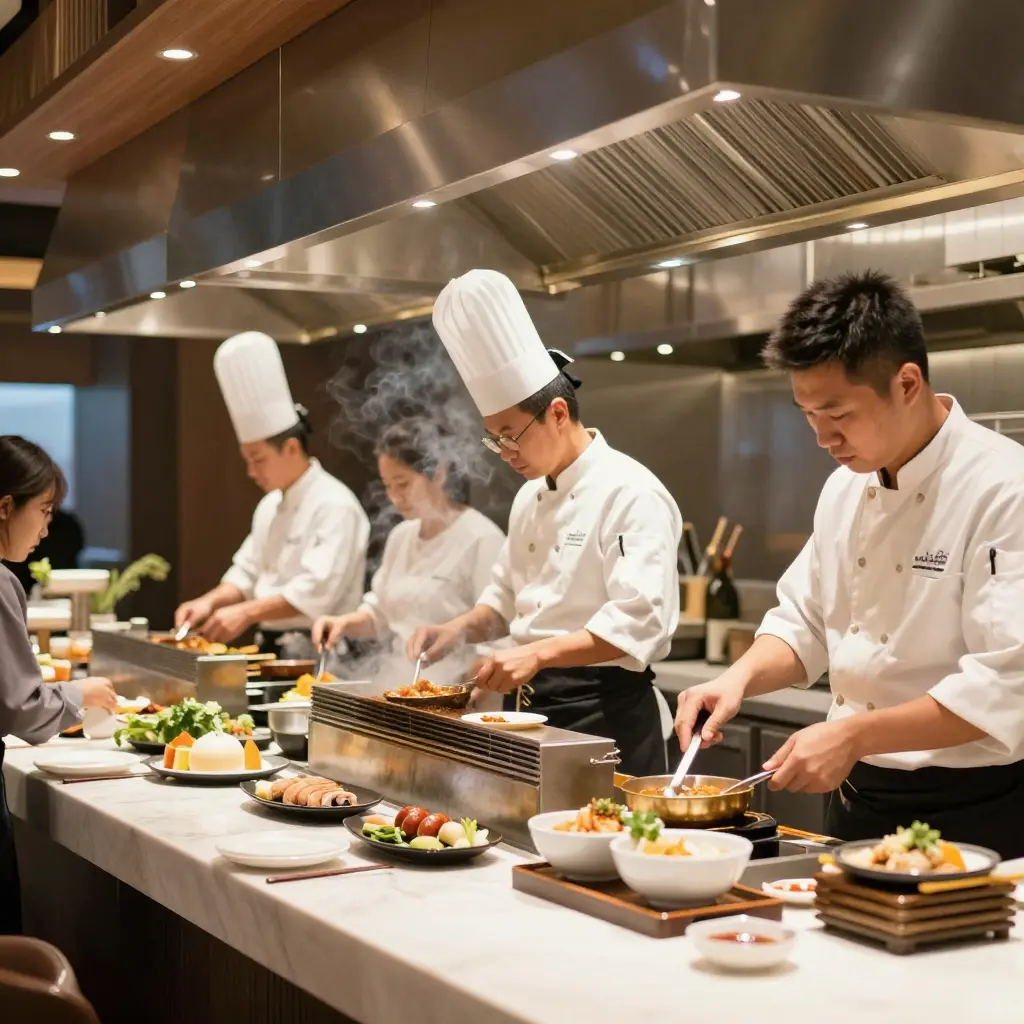
A make-up air shortfall happens when a commercial kitchen exhausts more air outdoors than it draws back in. Every hood, fan and grease-removal system needs replacement air to match what it removes. When that balance tips, the building finds the difference wherever it can. Buffet island hibachi stations make this worse than most kitchens: food is cooked to order on high-output gas burners, open griddles and searing flat-tops placed right in the dining room, and guests watch it happen. Each station adds exhaust load without adding a dedicated supply path, so the deficit builds through a busy dinner service.
Hibachi cooking puts three demands on a room at once: heavy gas combustion, visible flame and smoke, and continuous operation for as long as the buffet is open. A well-designed hibachi grill supreme buffet operation treats its island stations as part of one balanced ventilation system, not as a decorative add-on. When the balance is missing, the symptoms surface in odd places, from doors that slam to hoods that cannot clear smoke.
- Symptoms to watch for: door drag, lingering smoke, hoods that lose capture, diners who feel stuffy heat — all signs of an unbalanced supply of replacement air.
- Root causes and code requirements: undersized supply fans, blocked intakes and island stations added one at a time, plus what mechanical codes and local inspectors expect for replacement air in commercial food service.
- Fixes that hold up: dedicated supply, tempered air, balancing and commissioning, without driving up energy costs.
If your buffet island hibachi stations run hot, smoky or uncomfortable, the cause is often physics rather than a failing appliance, and it is fixable with the right approach.
What Make-Up Air Is and Why Hibachi Stations Need It
At a buffet island hibachi station, cooking and ventilation form one loop. An exhaust hood sits directly above the griddle or grill and pulls a large volume of air upward, away from the cooking surface. That air does not simply vanish. For the kitchen and dining room to stay balanced, an equal volume has to be brought back in. That replacement air is called make-up air, and it is one of the most overlooked parts of a hibachi buffet build-out.
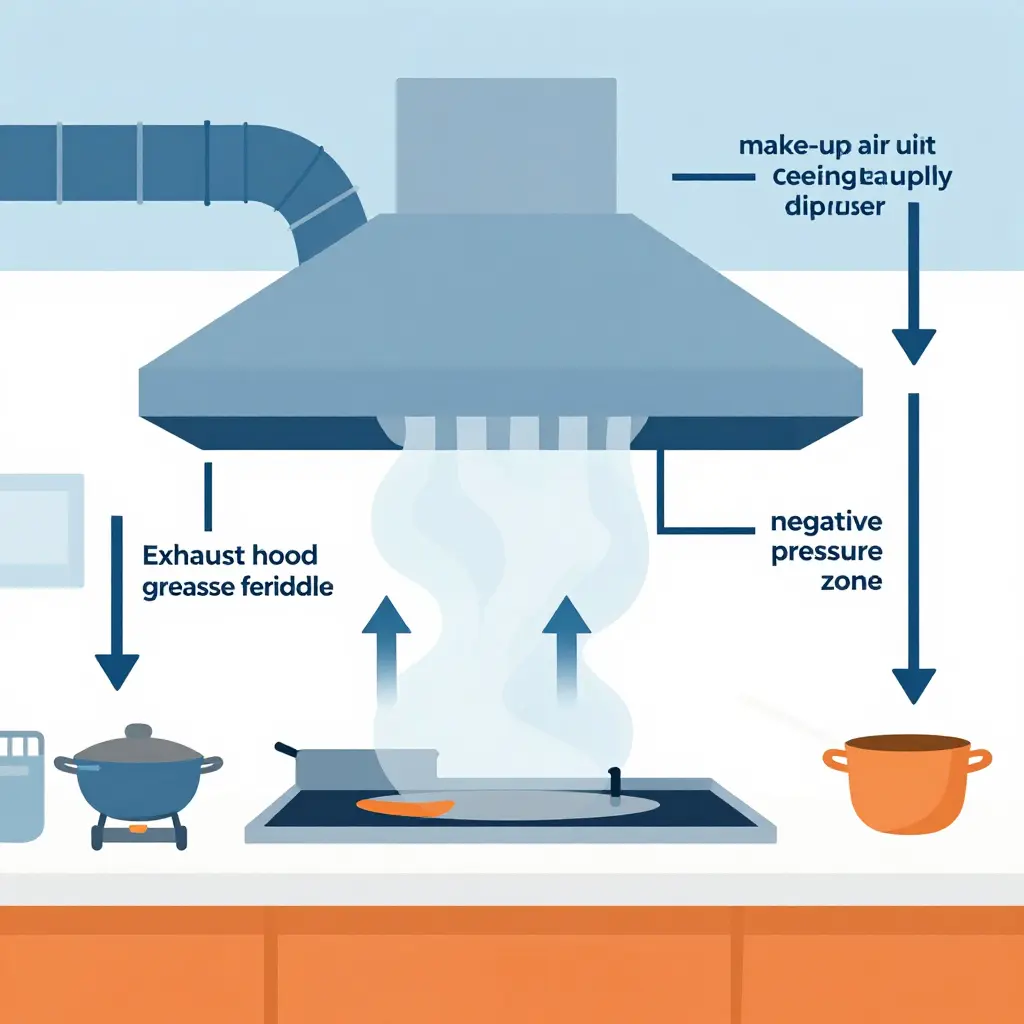
When the exhaust hood moves more air than the room can supply, the building is left short. Operators call this a make-up air shortfall. A shortfall shows up as heavy doors that are hard to open, whistling gaps around exterior doors, and hoods that seem to lose their pull exactly when the station gets busy.
Why hibachi cooking pushes exhaust volume up
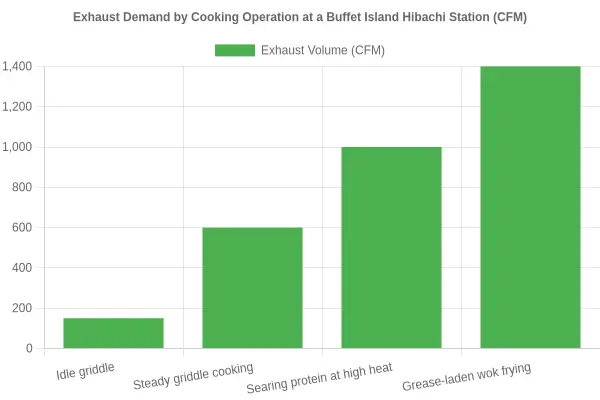
Hibachi griddles are exhaust-hungry by design. A wide flat-top griddle runs hot, and the cooking style throws off a lot of airborne material:
- Steady heat and steam rise across the full width of the griddle.
- Searing produces sudden bursts of smoke and vapor as proteins hit the hot steel.
- Grease-laden vapor rises off the griddle and coats nearby surfaces if the hood does not capture it.
Each one raises the volume of air the exhaust hood must move, and the peaks — not the average — set the requirement.
Why a buffet island concentrates the demand
A buffet island layout packs several cooking surfaces into one compact zone. Instead of spreading griddles and grills along a wall, the island groups them together, often a teppanyaki-style griddle, a grill and a wok or sauté station within a few feet of one another. All of that exhaust load lands in a single pocket of the room. The hood over one part of the island competes for air with the hood over the next, so make-up air has to be delivered into that zone rather than drifting in from a distant diffuser.
Negative pressure, air balance, and pressure differential in plain terms
- Air balance means the air going out equals the air coming in. A balanced kitchen feels neutral, and you do not notice airflow at the doorways.
- Negative pressure is what happens when exhaust wins. More air leaves than enters, so the room pulls air from wherever it can — hallways, restrooms, loading doors.
- Pressure differential is that imbalance measured between the kitchen and the surrounding spaces. A small, controlled differential keeps cooking odors contained. A large one fights back against the hood.
If you want a simple picture, think of a balloon. The exhaust hood is a slow leak, and make-up air is the breath that keeps the balloon from collapsing inward.
The three functions of make-up air
Make-up air is not just “air.” It is a system with three jobs:
- Replacing exhausted volume. The hood removes hundreds to thousands of cubic feet of air per minute. Make-up air supplies that same volume so the exhaust fan is never starved.
- Controlling pressure. Matching supply to exhaust keeps the building at a small, intended pressure differential. That holds smoke, heat and odors in the cooking zone instead of letting them migrate into the dining room.
- Improving indoor air quality. Conditioned make-up air brings in filtered, tempered outdoor air and helps dilute grease-laden vapor, CO2 and cooking byproducts that would otherwise recirculate.
Neglect any of the three and the result is a make-up air shortfall, and hibachi buffet stations are usually where it shows first.
A shortfall rarely announces itself. Operators usually find it through symptoms scattered across the cooking line, the exhaust hood and the dining room. Whether you run a compact hibachi grill supreme buffet or a multi-station operation, the table below pairs what you can actually see and feel with the underlying cause that typically produces it.
Table: Matching observable symptoms to likely root causes of make-up air shortfall at buffet island hibachi stations
| Observed Symptom | Likely Root Cause |
|---|---|
| Entry or back doors are hard to pull open, then slam shut on their own | The building is under negative pressure because exhaust air outpaces the make-up air being supplied |
| Hood fails to capture smoke and grease, letting it spill into the room | Insufficient make-up air volume or unbalanced supply collapses the hood’s capture velocity |
| Burner flames are uneven, lazy, yellow, or lift off the grates | Starved combustion air as depressurization pulls against the appliance’s intake |
| Cooking odors drift into the dining room instead of rising up the hood | Negative kitchen pressure routes fumes along the path of least resistance away from the exhaust |
| Grease condenses on cold walls, windows, and ceiling tiles | Grease-laden air escapes capture and settles on cool surfaces where it condenses |
| HVAC unit short-cycles on and off throughout service | Pressure imbalance and pressure-driven drafts keep tripping sensors or swinging the thermostat |
| Make-up air unit roars at full output yet the kitchen still feels stuffy | Exhaust is oversized or the make-up air unit and ductwork are undersized for the load |
| Guests near the island complain of cold drafts or whistling air | Untempered or poorly distributed make-up air creates turbulent, uncomfortable airflow |
Every symptom here traces back to one deficit: the volume of air supplied is not keeping pace with the volume exhausted. Rebalancing the two fixes them together.
Operational and Compliance Impact of an Unresolved Make-Up Air Shortfall
When a buffet island hibachi station runs short on replacement air, the exhaust fans pull harder than the space can supply, and the ventilation system settles into persistent negative pressure. That one imbalance affects air quality, food safety, comfort and code compliance at the same time.
Food safety tends to suffer first. Grease-laden vapor has nowhere to go but into the dining room and kitchen, where it settles on prep surfaces, hood filters and walk-in gaskets. That film on food-contact surfaces is a sanitation problem, and radiant heat from under-ventilated hibachi grill menu stations makes conditions worse. Guest comfort comes next, because an overtaxed HVAC system cannot offset the added heat and humidity, so nearby tables feel stuffy or smoky. Complaint patterns shift toward “too hot,” “smells like grease” and “smoke in my eyes,” which erodes repeat visits. Staff on the line absorb the rest: heat stress, fatigue and headaches at under-ventilated stations, which drive turnover and sick calls. Utility costs climb as HVAC equipment runs longer and harder to compensate, adding steady pressure to operating cost alongside the fixed cost of the buffet itself, which you can weigh against how hibachi grill and supreme buffet pricing is structured. Finally, persistent negative pressure can run afoul of energy code requirements and mechanical inspection rules. Many jurisdictions require balanced ventilation, and inspectors can flag or de-rate systems that fail make-up air verification.
The Four Highest-Cost Impacts
- Food safety exposure — grease-laden vapor and heat build-up on prep surfaces and food-contact areas
- Guest comfort and revenue loss — complaint-driven dissatisfaction that reduces repeat visits
- Staff working conditions — heat stress, fatigue, and turnover costs at under-ventilated stations
- Utility and code compliance penalties — overtaxed HVAC spend plus negative pressure inspection failures
Measure and rebalance make-up air whenever grill capacity or hood layout changes, not only at installation. Track static pressure and guest complaint themes together, so a shortfall is caught before it becomes a compliance violation or a habit of lost customers.
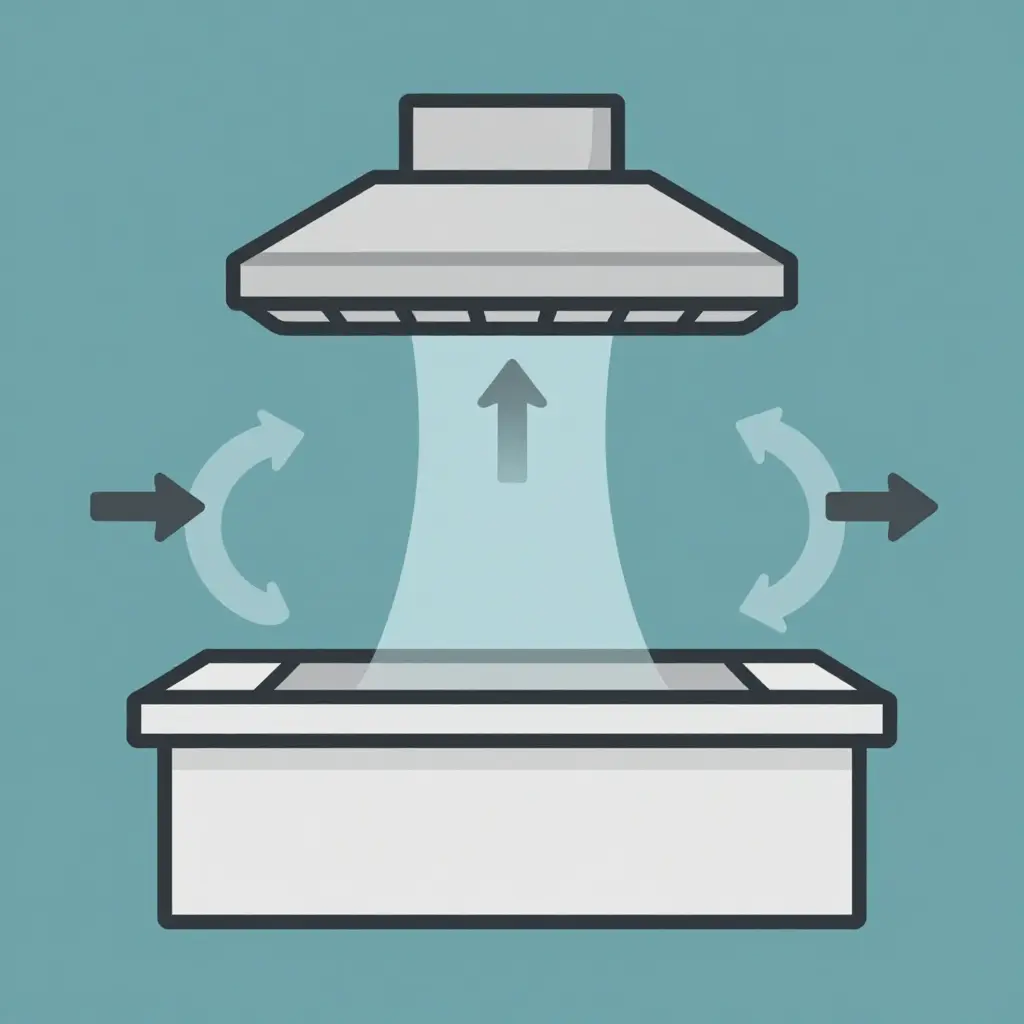
The schematic shows the intended air balance at a buffet island hibachi station: the exhaust hood pulls contaminated air upward and away from the cooking surface, while perimeter supply diffusers push make-up air inward to replace it. When the two flows are matched, a stable directional path forms around the grill. When supply falls short, the hood’s upward pull wins and the diagram’s balance tips toward negative pressure.
Diagnostic Checklist for a Make-Up Air Shortfall
Run this checklist when cooks report smoke hanging over the buffet island hibachi stations, guests complain about lingering grease odors, or kitchen doors become noticeably hard to pull open. It is also worth running after any menu expansion, equipment swap or change to cooking hours, because a make-up air unit that once matched demand may fall behind. Documenting what you find today gives you a baseline for future adjustments, and reviewing your station layout alongside existing hibachi grill and supreme buffet photos helps you picture how supply and exhaust interact.
- Measure the pressure differential across the kitchen entry door and record whether the dining room is being pulled toward the buffet island hibachi stations.
- Compare the exhaust hood rated CFM against the make-up air supply CFM to confirm both sides of your air balance are roughly matched.
- Check whether every entry door, transfer grille, and damper operates freely rather than sticking or slamming shut from negative pressure.
- Verify the make-up air unit run schedules against actual cooking hours so supply fans are not shutting off while hibachi grills are still lit.
- Inspect make-up air filters for grease loading and replace them whenever airflow visibly drops.
- Confirm the exhaust hood filters are clean and seated correctly so capture velocity is not reduced.
- Watch flame and smoke behavior at each hibachi station to see whether combustion air is being starved by unbalanced pressure.
- Test with a smoke pencil or handheld manometer at the hood face to confirm air is being drawn inward rather than pushed away.
- Cross-check whether recent renovations added exhaust without adding matching make-up air capacity.
- Log every reading so you can compare air balance results after each adjustment or repair.
If you find a shortfall, the exhaust hood is removing more air than the make-up air unit supplies. Rebalance supply and exhaust before cooking performance and guest comfort suffer.
Exhaust vs. Make-Up Air: Where the Gap Shows Up
Buffet island hibachi stations pull far more air out of the room than most building systems put back in. The chart below compares the rated exhaust volume against the available make-up air volume across five common station configurations.
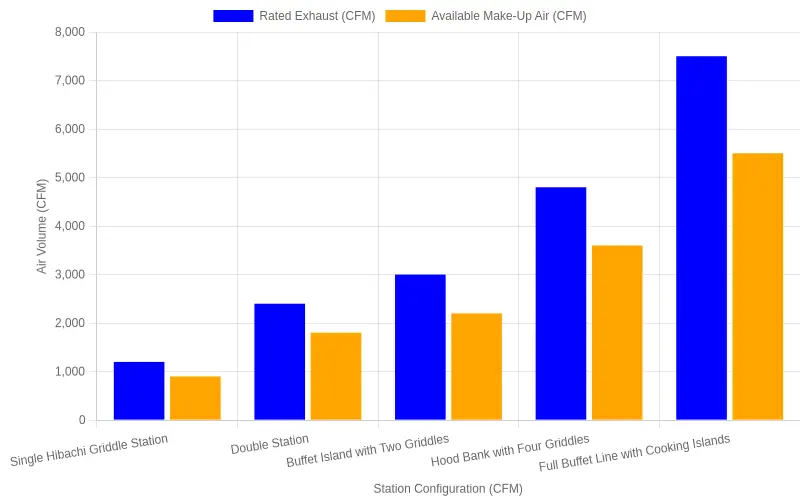
| Station Configuration | Rated Exhaust (CFM) | Available Make-Up Air (CFM) | Shortfall (CFM) |
|---|---|---|---|
| Single Hibachi Griddle Station | 1200 | 900 | 300 |
| Double Station | 2400 | 1800 | 600 |
| Buffet Island with Two Griddles | 3000 | 2200 | 800 |
| Hood Bank with Four Griddles | 4800 | 3600 | 1200 |
| Full Buffet Line with Cooking Islands | 7500 | 5500 | 2000 |
In every configuration the gap between the two bars is the make-up air shortfall, so the larger the station, the more air the ventilation system must find elsewhere. Operators planning these stations can review how the buffet layout affects ventilation needs before finalizing equipment specs.
Codes and Standards Governing Make-Up Air
Commercial cooking areas are regulated by two layers of rules. Building codes focus on life safety, fire separation and structural integrity, while mechanical codes govern airflow rates, duct construction and the performance of kitchen ventilation equipment. Read together, they explain how much air an exhaust hood must remove and how that air must be replaced.
The underlying principle is balance. Every exhaust hood pulls a set volume of air out of the kitchen each minute. Codes require that a defined share of that exhausted air be supplied back as make-up air so the building does not run under strong negative pressure. When supply cannot keep pace with exhaust, the space develops a make-up air shortfall. That shortfall can weaken hood capture, draw cooking odors and combustion gases toward dining areas, and make doors difficult to open.
Permitting and inspection usually focus on whether the design matches what is installed. Reviewers compare the exhaust and supply schedules, confirm hood ratings and duct materials, and check that measured airflow meets the approved figures. Because operating jurisdictions amend the model codes in different ways, operators planning new sites should confirm the local code edition and their equipment plan early, much as they would study region-specific planning details such as this Las Vegas menu and equipment overview.
Code-Related Considerations
- Exhaust rate: The mechanical code sets minimum airflow for each hood based on cooking type and duty, so buffets with visible island hibachi stations are often treated as heavy-duty cooking.
- Make-up air ratio: A defined share of exhausted air, commonly a large majority, must be replaced by supplied air to keep the building close to neutral pressure.
- Hood design and capture: Hood overhang, mounting height, and side curtains affect how well the hood contains smoke and grease-laden vapor.
- Duct and grease management: Ducts must be built from approved materials with proper clearances, and grease filters need scheduled cleaning to stay compliant.
- Supply air conditioning: Codes and good practice favor tempering supply air rather than dumping untreated outdoor air into occupied space.
- Documentation and commissioning: Approved drawings, balance reports, and inspection records show that the installed system performs as designed.
Untreated Versus Conditioned Make-Up Air
Bringing in untreated outdoor air meets the letter of many ventilation requirements, but it can create problems. In cold or hot climates, raw outdoor air forces the HVAC system to work harder and can make dining areas uncomfortable for guests seated near the grill stations.
Conditioned make-up air, delivered through a tempered supply unit, satisfies the same airflow requirement while maintaining comfort. It also supports year-round compliance, since the required share of replacement air can be supplied without sacrificing indoor conditions during peak service.
Remediation Strategies for a Make-Up Air Shortfall at Buffet Island Hibachi Stations
A make-up air shortfall at buffet island hibachi stations is rarely solved by one change. The rooms around island grills exhaust far more air than they replace, so the fix is always a matter of rebalancing supply, exhaust and schedule. The four strategies below move from the most capital-intensive to the least, and each one carries a different trade-off in cost, comfort and complexity.
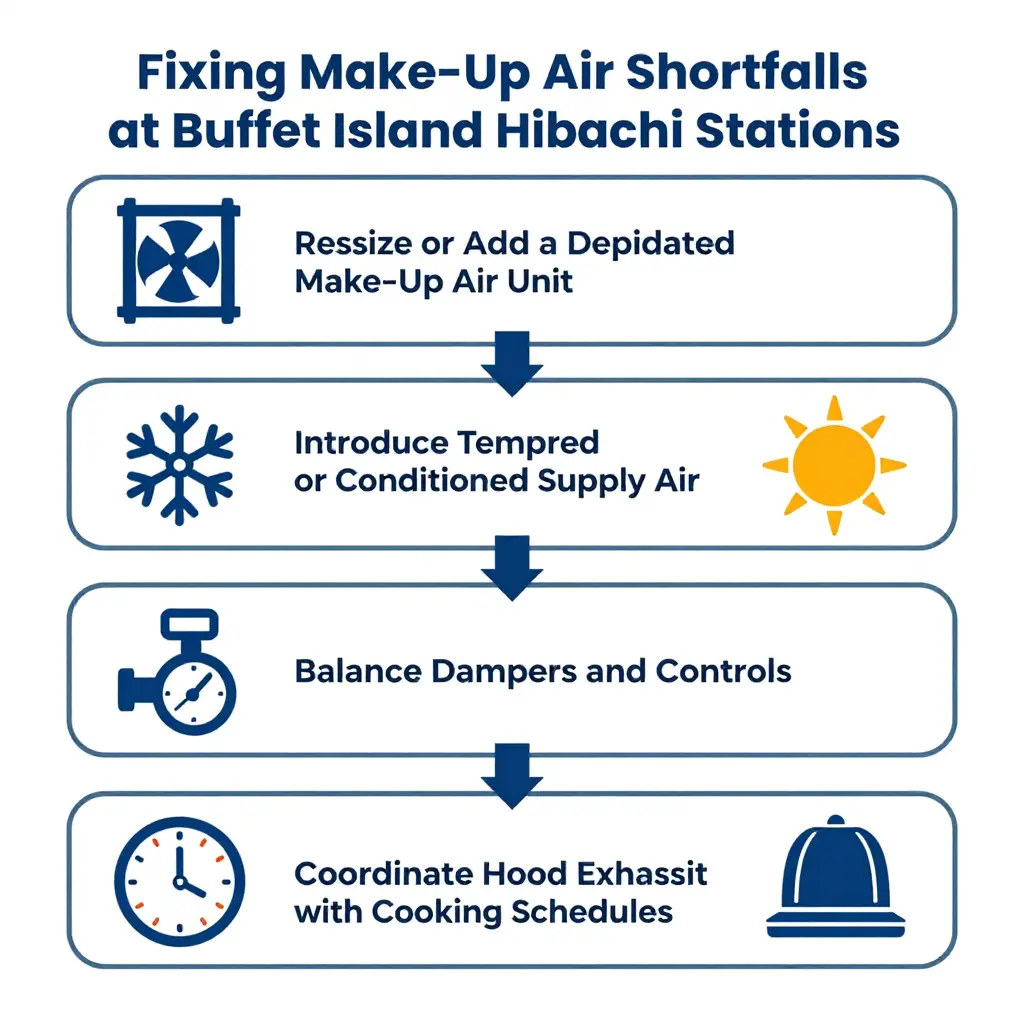
Resizing or Adding a Dedicated Make-Up Air Unit
A hood only moves as much air as the room allows it to pull, so a dedicated make-up air unit restores the missing volume at its source. On most island-grill sites the original unit was specified for the kitchen, not the buffet line, leaving the dining-side hoods starved. Resizing or adding a unit is the most reliable cure, but it is also the most expensive and the hardest to fit into an operating building.
Introducing Tempered or Conditioned Supply Air
Untempered replacement air solves the airflow problem and creates a comfort problem, because it dumps outdoor temperature straight onto seated guests. Tempering or conditioning that supply air moderates the temperature and humidity before it reaches the dining room. The result is a noticeably better guest experience, though it adds mechanical capacity and ongoing energy cost that operators must plan for.
Balancing Dampers and Controls
Correct air balance depends on dampers that actually proportion supply to exhaust across zones. Pressure testing often reveals that a few throttled or seized dampers, not missing equipment, cause the deficit. A commissioning-level balance pass is a low-cost way to recover capacity, but it delivers only what the existing system can give and needs periodic re-tuning.
Coordinating Hood Exhaust Schedules with Cooking Schedules
Running every exhaust fan at full speed during quiet periods pulls air the room cannot replace. Scheduling exhaust to match actual cooking shrinks the shortfall. This is the cheapest and most flexible option, but it depends on disciplined staff and controls, and turning it down too far can starve the hoods during a rush.
Trade-Offs at a Glance
- Dedicated make-up air unit: highest upfront cost, strong and permanent airflow fix, moderate installation complexity.
- Tempered or conditioned supply air: moderate cost, best guest comfort, higher operating energy use.
- Damper and control balancing: low cost, comfort depends on the base system, lowest complexity but needs monitoring.
- Exhaust-to-cooking scheduling: minimal cost, comfort-neutral, highest reliance on staff and controls.
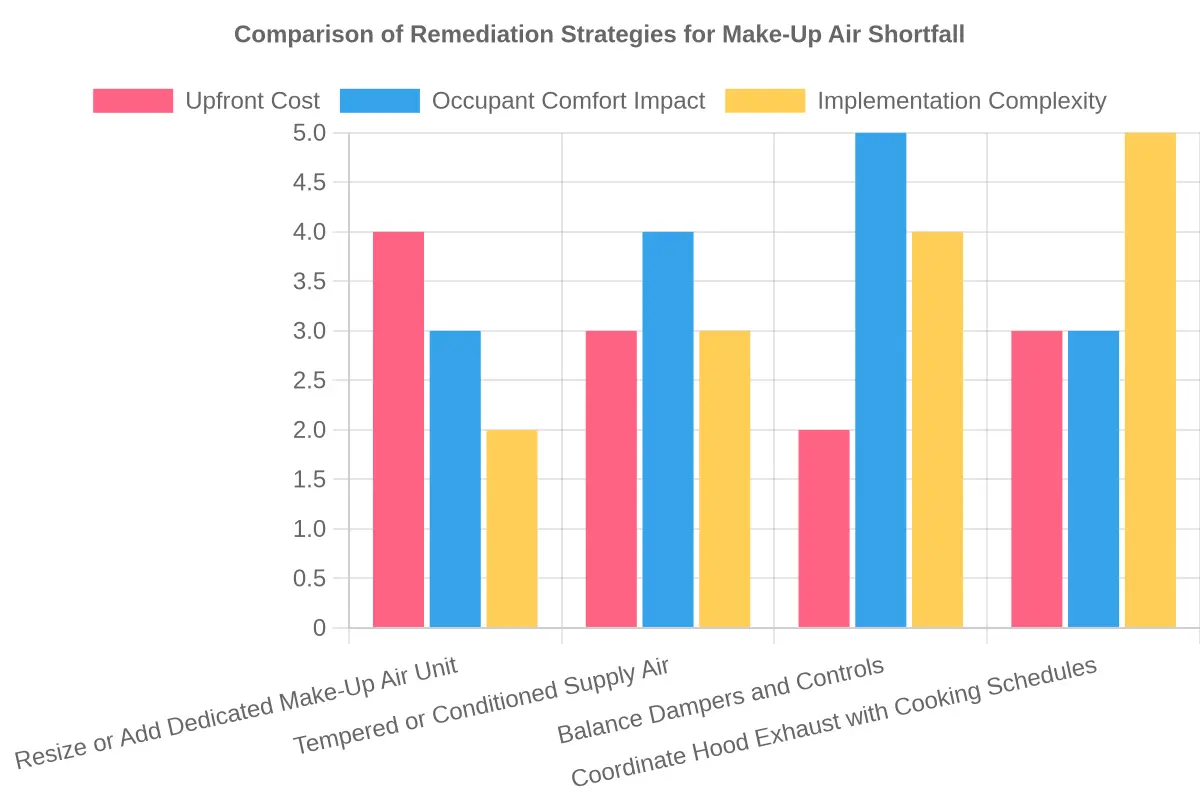
Used together, these four moves form a sequence: balance and schedule first to capture cheap gains, then invest in a dedicated make-up air unit or tempered supply where the shortfall persists. Operators who treat the problem as a full hibachi grill and supreme buffet operation rather than a single hood tend to reach a stable, comfortable air balance sooner.
Buffet island hibachi stations exhaust enormous volumes of smoke and grease-laden air, so the make-up air strategy you choose determines whether the room stays comfortable or gets slammed by island hibachi buffet operations that constantly fight drafts, humidity and pressure problems.
Table: Make-up air solution options for buffet island hibachi stations
| Solution | How It Works | Relative Cost | Best-Fit Situation | Key Limitation |
|---|---|---|---|---|
| Direct untreated outdoor make-up air | Raw outside air is pulled directly through wall or rooftop intakes to replace exactly what the hoods exhaust. | Lowest | Mild climates and low-seat islands where supply air will not blow onto diners. | Delivers unconditioned air that creates drafts, humidity swings, and cold-spot complaints in winter. |
| Tempered make-up air unit | A dedicated unit heats (and sometimes cools) incoming air before it enters the dining area, matched to hood exhaust volume. | High | Year-round operations in cold or hot climates where guest comfort is non-negotiable. | Highest first cost and energy load; oversizing raises both construction and utility bills. |
| Evaporative-cooled make-up air | Outside air passes through a wet media pad to drop its temperature before being supplied near the island. | Moderate | Hot, dry climates where sensible cooling is enough to keep the space bearable. | Adds moisture, so it performs poorly in humid regions and can worsen grease vapor and condensation. |
| Variable-volume make-up tied to hood controls | A control system modulates make-up airflow in step with hood fan speed as cooking demand rises and falls. | Moderate to high | Busy islands with shifting cook loads that want to cut energy during off-peak hours. | Requires commissioning and tuning; poor setup causes pressure swings that defeat the savings. |
| Transfer air from adjacent spaces | Conditioned air is drawn from surrounding dining or corridor areas to replace exhausted air instead of importing new outdoor air. | Low to moderate | Buildings with spare conditioned air and clean adjacent zones that can spare the volume. | Depends on available spill air; can starve adjacent spaces and pull odors or smoke where you do not want them. |
Caption: Each option above is judged on how well it closes the make-up air shortfall at buffet island hibachi stations while protecting guest comfort and operational cost.
To choose, weigh your local climate, hood exhaust volume and how much tempered air your central HVAC can spare, then pick the option that closes the make-up air shortfall with the least strain on comfort and energy.
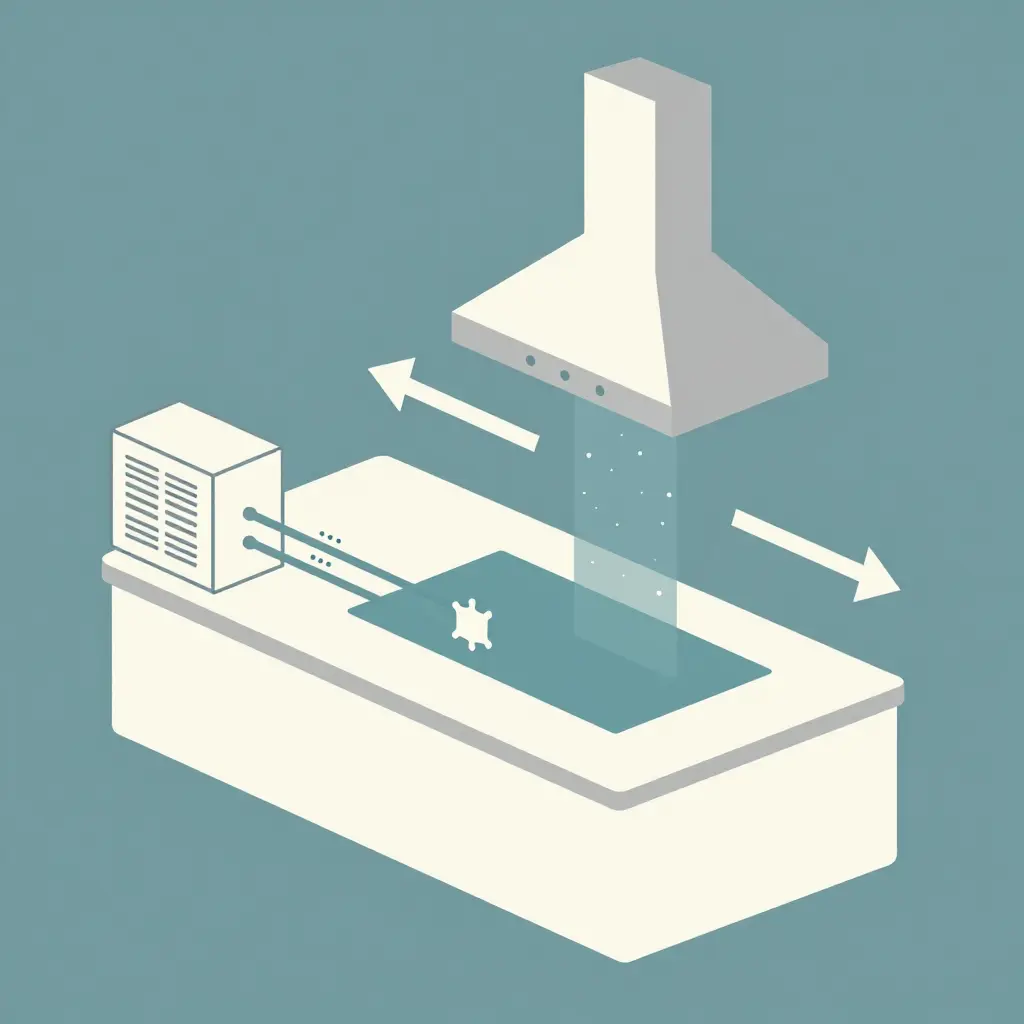
This corrected schematic shows what a healthy, balanced island buffet hibachi station should look like after remediation. A make-up air unit on the left pushes tempered supply air through ducts and diffusers directly into the cooking zone, while the exhaust hood above the island draws smoke and heat up and out through the exhaust duct. The inbound and outbound arrows are drawn the same size on purpose: that visual balance is the whole point, because it signals a neutral pressure condition. When supply and exhaust move roughly equal volumes of air, the station stops fighting itself: doors stop sucking shut, grease-laden smoke stays captured, and guests seated near the buffet are not blasted by a cold draft.
FAQ: Make-Up Air Shortfall at Buffet Island Hibachi Stations
What is a make-up air shortfall?
A make-up air shortfall happens when a kitchen exhausts more air than it brings in, leaving the space under negative pressure. The exhaust hoods pull air out faster than the HVAC system and transfer fans can replace it. This imbalance makes the building draw air from wherever it can, including doors, drains and wall gaps. For buffet operators managing a busy hibachi grill supreme buffet, correcting that balance protects cooking performance and guest comfort.
How can you tell if your kitchen has one?
Common signs include doors that are hard to open or that slam shut on their own, whistling at gaps, and strong drafts near the buffet island. Grease and odors may also drift into the dining room, and hoods may struggle to capture smoke and steam from the grills. A licensed technician can confirm the condition with a pressure and airflow test.
Does opening a door or window fix it?
Opening a door or window can add a little make-up air, but it is not a real fix. It draws in untreated, humid or cold air that can raise energy costs and trigger guest comfort complaints. It also rarely matches the exhaust volume your hibachi station demands during peak service.
How much make-up air does a hibachi station need relative to exhaust?
For each hibachi grill menu station, plan to supply roughly 80 to 90 percent of the air you exhaust, leaving the rest as intentional negative pressure to contain odors. Mechanical codes generally require make-up air to be approximately equal to the exhaust; the 80 to 90 percent figure is the common split between a dedicated supply unit and transfer air. Exhaust hoods over hibachi grills typically move far more air than a standard cooking line, and oversized exhaust without matched supply is the most common cause of a shortfall.
Does a shortfall affect energy costs and food safety?
Yes. A shortfall forces conditioned air to escape and pulls outside air in, so HVAC systems work harder and energy costs climb. It can also weaken hood capture, allowing grease-laden air and contaminants to linger above food. In extreme cases, back-drafted appliances can pull combustion gases back into the kitchen.
How often should air balance be re-verified?
Re-verify kitchen ventilation balance at least once a year, and any time you swap hoods, add cooking equipment or reconfigure the buffet line. Busy operations may benefit from a check every six months. Keep the most recent balancing report on hand for health inspections and equipment warranties.
Quick Reference
| Question | Short Answer |
|---|---|
| What is it? | Exhaust exceeds supply, creating negative pressure |
| Warning signs | Slamming doors, drafts, weak hood capture |
| Door or window fix? | Temporary only, raises energy costs |
| Supply target | About 80 to 90 percent of exhaust volume |
| Cost and safety impact | Higher energy use, weaker hood capture, back-drafting risk |
| Re-verification | At least annually, or after equipment changes |
Conclusion: A Shortfall You Can Measure and Fix
A make-up air shortfall at buffet island hibachi stations is not an unavoidable quirk of running a high-heat cooking line. It is a measurable, correctable ventilation imbalance that shows up in pressure readings, hood capture tests, and the complaints your staff field every shift. Treating it as a permanent condition wastes energy, undermines guest comfort and hides a fix that is usually well within reach.
Three things to hold onto:
- Diagnostic logic: Measure before you guess. Compare exhaust and supply volumes, log differential pressure at the hood, and watch door-draft behavior during peak service to confirm the shortfall.
- Compliance stakes: Local mechanical and fire codes set minimum ventilation and capture standards, and falling short invites inspection violations, denied permits and added liability.
- Corrective options: Rebalance dampers, add or resize make-up air units, adjust station placement, and revisit menu items that generate the heaviest load.
Looking ahead, the smartest operators schedule regular air balance checks instead of reacting to a crisis, and they plan menu, layout and ventilation as a single decision rather than three separate ones. When airflow becomes a design input instead of an afterthought, you stay ahead of both the inspector and the dinner rush. For a live benchmark, it helps to find a hibachi grill supreme buffet near me and observe how a well-balanced operation handles peak demand.