
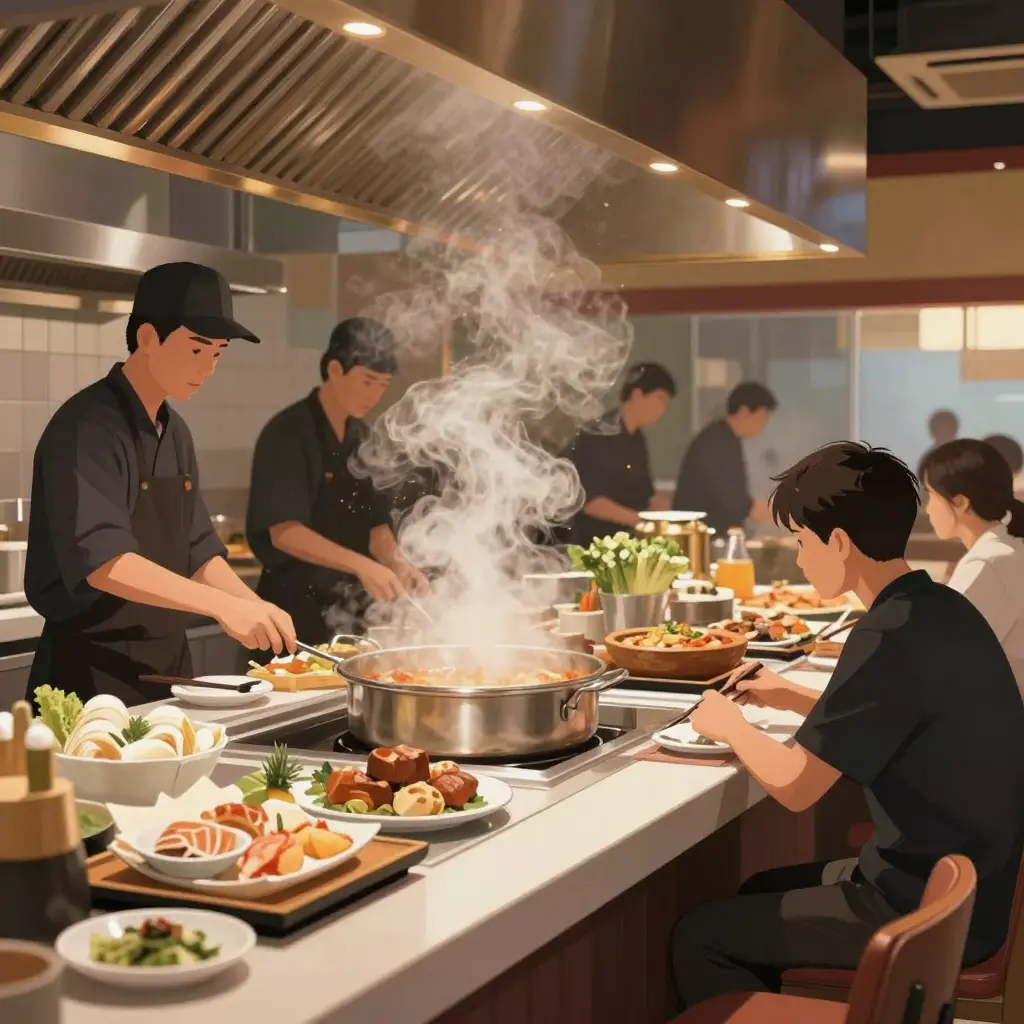
A buffet hibachi line that serves two seating waves every night pushes far more airborne grease into its exhaust than a conventional single-service restaurant does. That heavier load shortens the safe grease duct cleaning interval, and it means a generic quarterly or semi-annual schedule will not keep the duct within code limits. If you own, manage, or maintain this kind of kitchen, start with the duty cycle: two full waves keep the exhaust running at close to double the load of a standard restaurant.
A buffet hibachi line does two things at once. Teppan griddles sear continuously while the buffet runs all night, and the combination sends grease-laden vapor into the duct at a rate most hood systems were never sized to handle.
Each seating wave restarts that load. More protein hits hot steel, more moisture flashes off as vapor, and more aerosolized fat cools and settles along the plenum, the horizontal runs, and the fan housing.
For owners and facility managers, the practical consequence is a condition-based cleaning interval instead of a calendar-based one. For maintenance staff, it means checking filters, plenums, and horizontal duct runs more often and writing down the grease depth you actually find.
What follows is how the load builds, what the fire code actually asks for, and how to tell when your current interval has stopped matching your kitchen.
Why Two Seating Waves Load the Duct Faster
Two seating waves don’t simply mean the kitchen cooks twice as long. They compress roughly twice the grease output into the same window, which changes how the duct loads.
The extra food matters, but the overlap between waves matters more.
More grills firing at once
Each wave fires several teppan grills at the same time. A dozen burners come on within the same minute, and each one sends up a plume of grease-laden vapor. A single wave still leaves an hibachi exhaust hood time to breathe between orders. Back-to-back waves don’t: through a packed double seating, the plume never really drops.
Three effects that compound
- Twice the cook cycles. Two waves mean roughly double the searing, flipping, and oil flashing, so total grease output climbs. Each wave also tends to begin while the hood is still saturated from the last one.
- Higher peak exhaust temperatures. The hood pulls heat from several grills at once, so the vapor enters hotter and stays airborne longer, carrying more atomized grease deeper into the system before it can cool.
- Less recovery time between waves. One wave might leave a 20-minute buffer for grease to settle and filters to drain. A packed double schedule can cut that gap to five minutes or less.
How the vapor travels from grill to duct
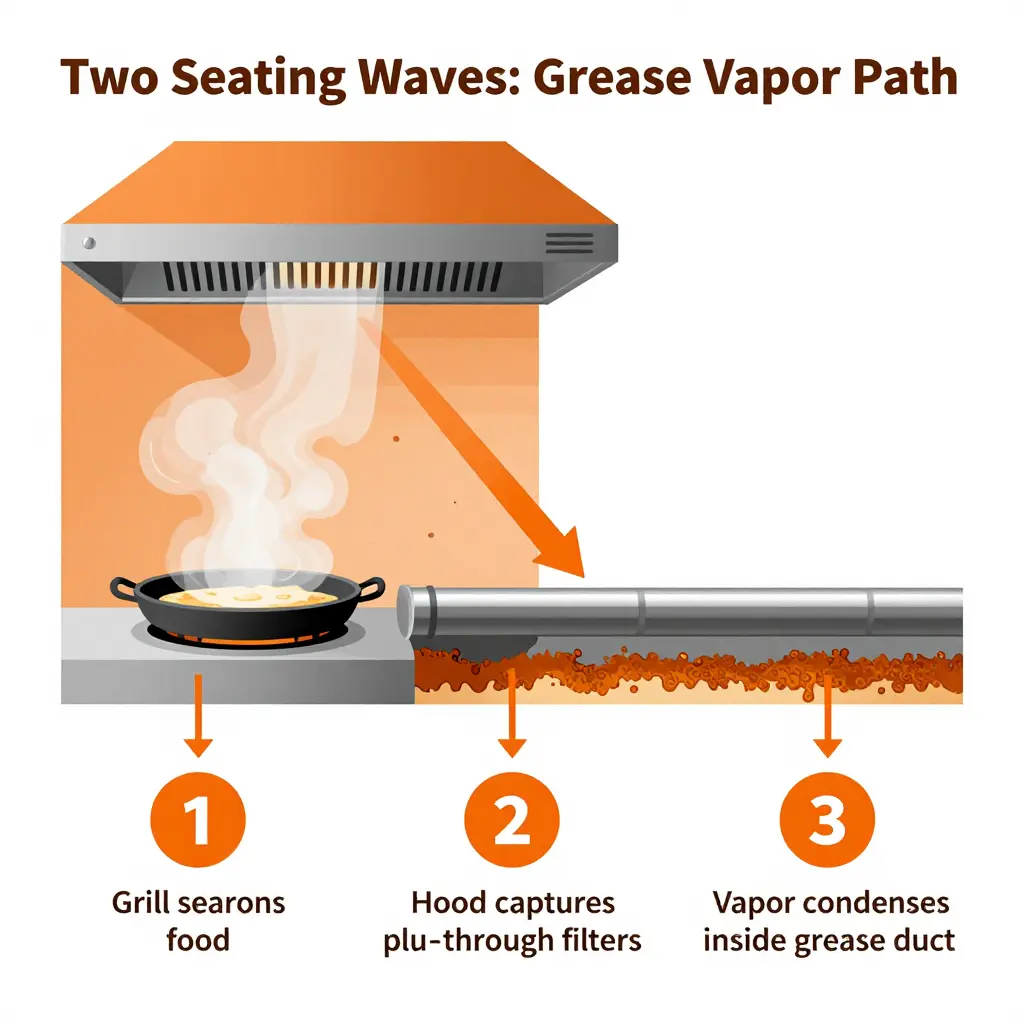
- A teppan grill sears food, flashing oil and moisture into a fast-rising plume of smoke and vapor.
- The hibachi exhaust hood captures that plume and pulls it through baffle filters that trap the heaviest grease droplets.
- Whatever slips past the filters enters the grease duct, where cooler walls cause the remaining vapor to condense into sticky, flammable residue.
What this does to the interval
The interval between cleanings has to shrink. Two seating waves double the grease load and halve the recovery window, and those two effects multiply rather than add.
The table maps common operating conditions to a cleaning interval and shows the schedule moving from quarterly toward monthly and beyond as cooking hours and seating waves rise.
Recommended Grease Duct Cleaning Interval by Operating Condition
| Operating Condition | Daily Cooking Hours | Seating Waves per Night | Recommended Cleaning Interval | Risk Level |
|---|---|---|---|---|
| Light buffet service | 4-6 hours | 0-1 | Quarterly | Low |
| Single seating wave | 6-8 hours | 1 | Every 2-3 months | Moderate |
| Two seating waves (focus case) | 8-10 hours | 2 | Monthly to every 6 weeks | Elevated |
| Three-plus seating waves | 10-12+ hours | 3+ | Every 2-4 weeks | High |
| Heavy hibachi production | 12+ hours | Continuous | Every 2 weeks or more often | Very High |
Most fire codes do not fix a single number. They allow grease duct cleaning intervals ranging anywhere from quarterly down to monthly or more frequent, depending on the volume of grease produced during cooking. A busy two-wave hibachi line typically falls closer to the monthly end of that range, so it pays to review your hibachi grill supreme buffet setup and treat the table as a starting point for your own inspection schedule.
What the Codes Require
Fire codes treat a kitchen exhaust system as a life-safety component, not a décor detail. NFPA 96, Standard for Ventilation Control and Fire Protection of Commercial Cooking Operations, is the governing document that most U.S. jurisdictions adopt and then amend through local fire codes. Together they set expectations for NFPA 96 grease duct cleaning and for the broader discipline of commercial kitchen exhaust cleaning.
Timing is the part operators most often get wrong. NFPA 96 does not hand you a fixed calendar interval that resolves every kitchen. It assigns the owner the responsibility to clean the exhaust system as often as necessary to prevent grease from accumulating to a hazardous level, and it points to the inspection as the mechanism that establishes that level of need. The standard’s commonly cited thresholds – roughly 1/16 inch of grease on the hood, filters, or ductwork and 1/8 inch in the fan housing – are action triggers found during inspection, not a default schedule. A wood-fired or high-volume charbroil line can hit those numbers in weeks; a low-output line may take far longer.
That is why inspections and cleanings are separate line items in a compliance log. An inspection is a documented evaluation that measures grease depth and records conditions. A cleaning is the physical removal of that accumulation. Many systems are inspected monthly but cleaned quarterly, or inspected and cleaned in the same visit only after the inspection proves the need. Confuse the two and you either over-spend on unnecessary service or, more dangerously, fail a fire marshal’s spot check.
Why a Two-Wave Hibachi Line Changes the Math
A buffet hibachi line running two seating waves every night produces near-continuous cooking with heavy oil aerosol, so its grease accumulation curve climbs far faster than a single-service restaurant’s. The code responds by requiring the operator to verify the real accumulation through inspection rather than assume a schedule.
What the codes mean in practice
No fixed calendar can tell you what a specific duct actually needs. Only a documented inspection – measured, recorded, and repeated on a defined schedule – determines the true grease duct cleaning interval.
Factors That Shorten or Extend the Cleaning Interval
- Cooking volume – Two nightly seating waves keep a full buffet hibachi line drafting hard for hours, accelerating grease buildup.
- Grill count – Every extra teppan grill adds more airborne grease to the airstream.
- Fuel type – Gas and electric griddles leave less soot and residue than charbroilers or solid-fuel cooking, which buys back time between cleanings.
- Hood capture efficiency – A correctly sized hood that catches smoke at the source keeps grease out of the duct.
- Duct length and horizontal runs – Long ducts with several horizontal runs let grease cool, settle, and pool, trapping residue.
- Filter maintenance – Cleaning or swapping baffle filters on schedule cuts carryover into the duct.
- Fryer use – A busy fryer station pumps vaporized oil into the shared exhaust.
- Building fire code – Local codes usually cap the maximum gap between cleanings no matter the load, so they can prevent you from extending the interval even when the duct looks clean.
Weigh them together and a buffet hibachi line running two seating waves each night lands closer to monthly than quarterly. No single factor pulls it back toward a semi-annual default.
Reading the Signs: When the Interval Is Too Long
A hibachi line like those at a hibachi grill supreme buffet can drift out of sync with its own workload when it serves two seating waves a night. A schedule built for one dinner rush stops matching the grease the kitchen now produces.
Watch for these:
-
Visible grease on the roof fan. Step outside and inspect the exhaust fan. A faint film is normal, but a sticky, dark coating spreading across the blades means deposits are building faster than your current schedule removes them.
-
Grease drips at the hood edges. Look along the rim of the hibachi exhaust hood. Oily streaks or drips mean grease is traveling where it should not, a clear sign the duct is carrying more load than it can shed.
-
Heavier filter loading. Filters that once lasted a week now clog in days. Frequent, heavy loading shows the line is pushing more airborne grease into the system with each seating wave.
-
Lingering odors. A faint cooking smell hours after service, or a greasy odor lingering near the hood, means residue is accumulating inside the duct instead of being carried away.
-
Increased fan strain. A louder fan, noticeable vibration, or reduced airflow points to restricted ducts and a motor working harder to move air.
When several of these show up together, shorten the interval instead of waiting for the next scheduled visit. All of them appear long before a fire risk does.
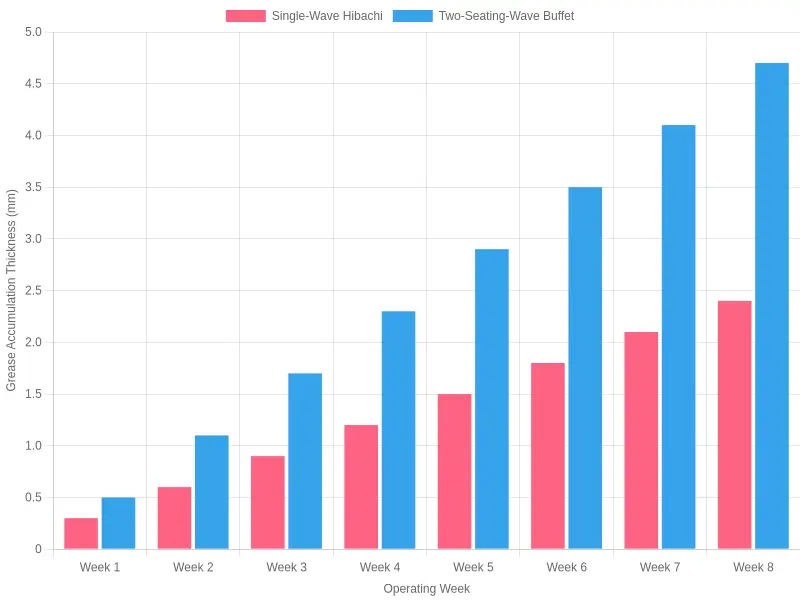
The chart above plots estimated grease accumulation thickness (in millimeters) in the exhaust duct over an eight-week operating period. Each week shows two side-by-side bars: one for a single-wave hibachi restaurant and one for a buffet hibachi line running two seating waves each night.
The two curves separate quickly. The single-wave operation climbs gradually from about 0.3 mm in Week 1 to roughly 2.4 mm by Week 8. The two-seating-wave buffet, working roughly double the cooking cycles, starts slightly higher at 0.5 mm and reaches approximately 4.7 mm by Week 8 – nearly double the buildup in the same timeframe. That steeper slope is the clearest argument for a shorter grease duct cleaning interval whenever a second dinner wave is added.
Industry Guidance on Grease Duct Cleaning Frequency
Fire codes, industry associations, and cleaning service providers all agree on one point: there is no single calendar answer for how often a kitchen exhaust system must be cleaned. The frequency follows how much grease the kitchen actually produces. For a buffet with a busy hibachi line running two seating waves a night, that load is high, and the schedule has to reflect it.
What the codes say
The cornerstone reference is NFPA 96, the fire code standard for ventilation control and fire protection of commercial cooking operations. It requires the hood, ducts, and fans to be inspected by a qualified person and cleaned as needed to prevent grease buildup, with the interval tied to cooking volume and fuel type rather than a fixed date. Industry associations, such as IKECA (the International Kitchen Exhaust Cleaning Association), and the service providers that perform commercial kitchen exhaust cleaning translate this into practical guidance for operators.
| Kitchen Type | Typical Cleaning Interval | Source Type |
|---|---|---|
| High-volume frying or hibachi cooking | Monthly to quarterly | Fire code / industry association |
| Moderate cooking volume | Every three to six months | Industry association |
| Light or low-volume cooking | Semi-annual to annual | Fire code / service provider |
These are general ranges, not fixed rules. NFPA 96 leaves the exact number to the authority having jurisdiction and to what the inspection actually finds.
What two seating waves add
Running two full dinner waves each night roughly doubles the fat, oil, and grease that rises into the ductwork compared with a single-service restaurant. That pushes a hibachi buffet toward the frequent end of the range – monthly cleaning, with shorter inspection checks in between. Treating the schedule as a fixed annual task is the fastest way to fall behind. Owners planning around these heavy loads often use high-volume hibachi buffet operations as the frame of reference when setting their maintenance calendar.
Common causes of non-compliance
- Grease buildup left above acceptable limits on hood and duct surfaces
- No written inspection or cleaning records to show the fire marshal
- Missing or blocked access panels that make the duct impossible to clean
- Overlooked components like rooftop fans and horizontal runs
- Scheduling by the calendar instead of by actual cooking volume
Most grease-duct violations trace back to scheduling by habit rather than by cooking load. A two-wave hibachi buffet has to lean on frequent, documented cleaning and inspection instead.
Reading the Diagram
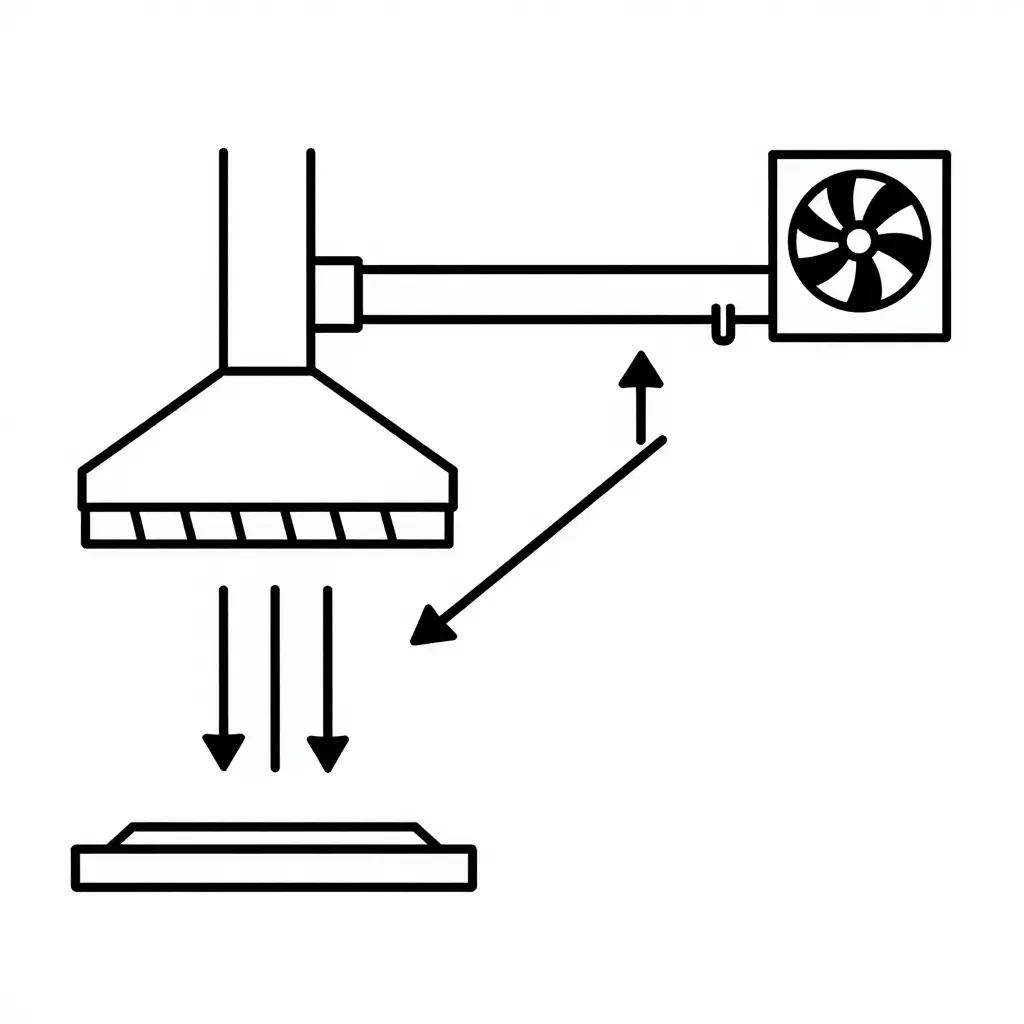
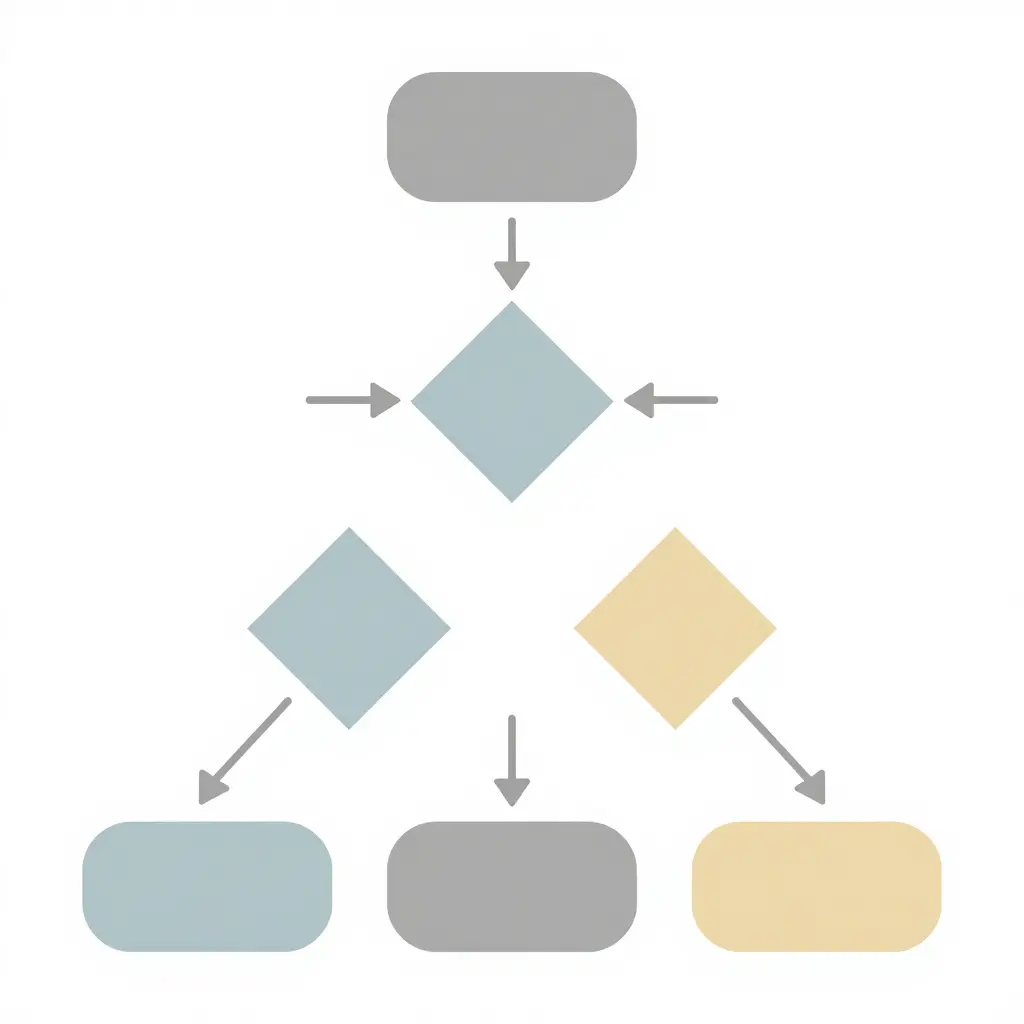
The chart reads top to bottom. It begins with a single start node at the top, then flows into a decision point that splits the logic in two: the left path represents a lighter load and the right path represents a heavier load. Each path continues into a second decision stage, and the arrows then funnel down into three outcome nodes across the bottom row. The shapes carry no words, but the sequence maps onto the three intervals below.
- Quarterly – the far-left outcome. This suits a hibachi line running a gentle schedule, where the two seating waves still leave long cooling and shutdown gaps between them. Grease never gets a chance to bake solid.
- Monthly – the middle outcome. This fits the typical buffet hibachi line that runs two full seating waves every night with steady grill use from open to close. Hot plumes keep pushing vapor into the hood, so residues build faster than a quarterly cycle can handle.
- More frequent – the right-hand outcome. Choose this when two seating waves are paired with long daily cooking hours, back-to-back teppanyaki turns, or an extended weekend crush that keeps the duct hot for hours on end.
Why the waves push you right
When guests arrive in two distinct waves, the griddle never fully cools off between them. The first wave loads the hood with cooking vapor, and the second wave hits before the grease has drained away. That overlap is what the diagram is built to capture: the more nights you run back-to-back waves, the further right your answer shifts.
Putting It to Work
Use the diagram as a quick mental checklist before your next service call. Count your seating waves, estimate your daily cooking hours, then trace the path that matches. To see how similar high-volume hibachi setups plan their maintenance, review how these buffet hibachi lines are configured and compare their layout to your own.
One Extra Rule of Thumb
Between scheduled cleanings, follow the diagram with a simple physical check. Open the access panel, run a light down the duct, and look for the telltale grease film along the inner walls. If you can already feel a tacky layer after only a few weeks, move one step more frequent, no matter what the flow chart initially suggested.
Building a Cleaning Schedule That Matches Your Seating Waves
When two seating waves run every night, your buffet hibachi line produces heat, smoke, and grease-laden vapor on a predictable rhythm. Rather than cleaning “whenever there’s time,” build your calendar around those waves. The rule is simple: inspect between waves, deep clean after the last guest leaves, and document everything.
Map Your Waves Before You Schedule Anything
Pin down exact start and end times. A typical double-wave night runs Wave 1 from 5:00-6:30 p.m., a 45-60 minute reset, then Wave 2 from 7:30-9:00 p.m. That between-wave gap is your best window for fast checks – hood filters, baffle alignment, and any visible grease trails on the canopy.
Set Your Grease Duct Cleaning Interval
Two waves a night roughly double the grease volume a single-wave operation handles. Treat the grease duct cleaning interval as a fixed commitment: inspect monthly, deep clean quarterly, and tighten the cycle if your log shows heavy buildup. This rhythm keeps you ahead of fire-code inspections and insurer requirements.
| Wave / Window | Action | Frequency | Owner |
|---|---|---|---|
| Between Wave 1 and 2 | Wipe canopy, check filters and baffles | Nightly | Line lead |
| After final closing | Full hood filter soak and rinse | Nightly | Closing crew |
| Post-week | Visual duct and fan inspection | Weekly | Maintenance |
| Post-month | Documented duct inspection | Monthly | Facility manager |
| Post-quarter | Full grease duct deep clean | Quarterly | Certified vendor |
Keep a Documented Log
Every inspection needs a date, initials, findings, and follow-up action. A simple binder or spreadsheet works, but it must be real and current. Inspectors and insurers ask to see the trail, not just the result.
Plan Roof Access Early
Rooftop fans and access hatches need advance scheduling. Coordinate with building management, confirm ladder and hatch safety, and book certified crews ahead of the quarter so the deep clean never slips during peak service.
Schedule Cleaning During Off-Hours
Do the messy work after the doors close or during a slow morning window. Deep cleaning mid-wave shuts down stations, hurts turnaround, and pressures the operating economics behind your per-person price. Off-hour cleaning protects both guest flow and your bottom line.
Traffic patterns vary, so tune the calendar to your market. Busy metro location-based operations near you may need a tighter interval than a quieter suburban site with fewer covers.
The Practical Takeaway
Match your schedule to your waves, not the clock. Inspect between seatings, deep clean after close, log every step, and lock in roof access well in advance. Do that, and your grease duct cleaning interval becomes a dependable routine instead of a fire-risk afterthought.
Where the Grease Actually Comes From
On a hibachi line running two seating waves each night, it helps to know which cooking stations do the heavy lifting when it comes to exhaust-system grease. Teppan griddle cooking dominates the picture, followed by deep fryers and the wok/buffet stations, with a smaller share from other cooking. That breakdown is useful when you’re sizing filters, planning cleaning intervals, and deciding where to focus your grease-duct maintenance budget.
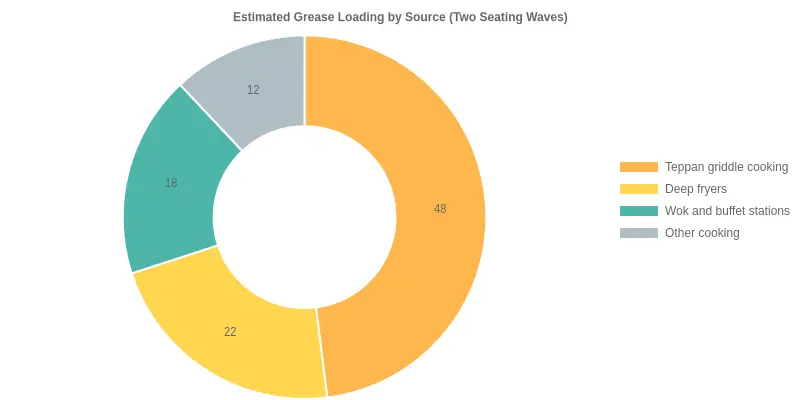
Because the teppan griddle alone accounts for nearly half of the airborne grease, it’s the surface most responsible for accelerating buildup in your ductwork. To see how a full hibachi and buffet operation is laid out across stations, you can explore the hibachi grill and supreme buffet configuration for context.
How the Interval Shifts Across the Year
The grease duct cleaning interval you set during a calm week is rarely the interval you keep all year. On a buffet hibachi line running two seating waves every night, the baseline is already tighter than a standard single-service kitchen, and the calendar pulls it tighter still.
Peak season and holidays do most of the work. During a slow stretch like late January or early September, you might stretch the grease duct cleaning interval toward 90 to 100 days. Once holiday buffet demand, summer tourism, and private event bookings pile up, that same interval compresses toward 35 to 45 days.
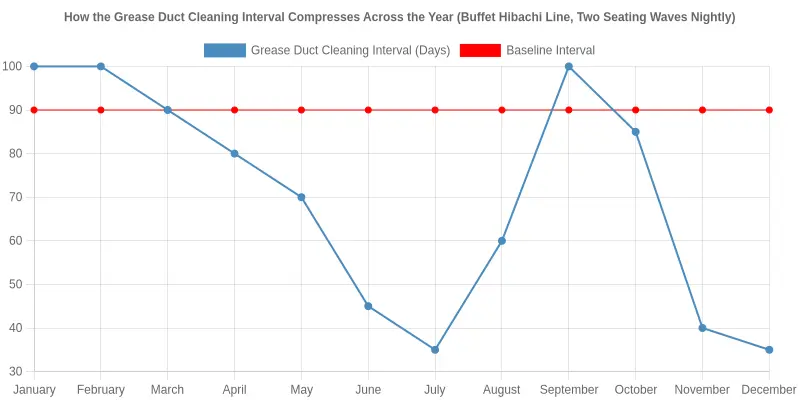
Holiday buffet demand is the biggest lever. From Thanksgiving through New Year, guests arrive in large parties, plate heavier portions, and linger over multiple passes at the hibachi station. That means more cooking time per cover and more airborne grease moving into the duct every single night.
Event bookings add bursts on top of the schedule. A single banquet or company party can double your throughput for one evening, pushing both seating waves to full capacity and forcing an out-of-cycle inspection you did not plan for.
Menu changes shift the load, too. Heavier use of high-fat items like fried rice, stir-fried beef, and griddle-seared seafood raises the menu-driven cooking load, which you can read more about in the full menu breakdown.
Taken together with the general operating context of a nightly hibachi buffet, these factors explain why a fixed interval fails during busy months.
Your interval should flex with the calendar rather than stay fixed, because seasonality, holiday buffet demand, and event bookings can all compress it well before your usual cleaning date arrives.
How Nightly Seating Waves Shorten Your Cleaning Interval
The more times your buffet hibachi line fires up in a single evening, the faster grease-laden vapor loads your exhaust ductwork. The line chart below shows how the recommended grease duct cleaning interval (in weeks) shortens as nightly seating waves climb from one to four:
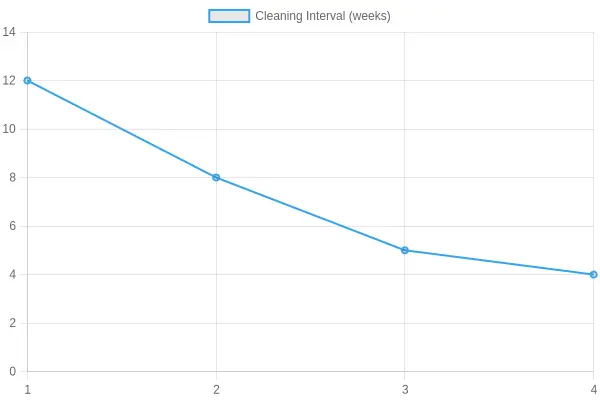
| Seating waves per night | Recommended cleaning interval |
|---|---|
| 1 | 12 weeks |
| 2 | 8 weeks |
| 3 | 5 weeks |
| 4 | 4 weeks |
Every additional seating wave multiplies the grease vapor your hood and duct system absorbs, so the safe window between professional cleanings collapses. A restaurant running two rounds a night – a common setup for busy locations – sits right in the middle of that curve, which means owners and facility managers should plan on a shorter cycle than a single-seating operation.
To see how a full-service hibachi and buffet floor operates across those repeated seatings, you can explore our main buffet experience overview to better gauge your own nightly volume.
Why the Interval Curve Bends So Sharply
- Grease accumulates non-linearly. Each seating wave adds another round of searing, smoke, and airborne fat that cools and sticks to duct walls.
- Heat cycles compound. Repeated heating and cooling makes deposits thicker and tackier, so buildup no longer matches the simple number of flips on the grill.
- Airflow declines quietly. As residue coats the duct, the exhaust fan has to work harder, and reduced airflow can trigger smoke problems and code concerns long before the duct looks dirty.
Treat this trend line as a planning baseline, not a hard rule. Local fire codes and NFPA 96 guidance still call for inspection at set frequencies, and your actual field conditions may shift the curve up or down. When in doubt, book an inspection earlier than the chart suggests.
Frequently Asked Questions
How often does a two-seating-wave hibachi buffet line need grease duct cleaning?
A hibachi line that cooks through two full seating waves each evening typically needs grease duct cleaning every one to three months. The exact schedule depends on how much grease the ductwork accumulates, which is driven by cooking volume, fuel type, and hood design. Because hibachi cooking is high-heat and grease-intensive, most two-wave operations fall on the shorter end of that range, closer to monthly than quarterly. As operators of a hibachi grill supreme buffet know, a busy service pattern pushes the interval toward the frequent side.
Does NFPA 96 set a fixed interval for cleaning?
No. NFPA 96 does not specify a fixed calendar interval for grease duct cleaning. Instead, it requires that the entire exhaust system be inspected and that cleaning be performed as needed so grease does not accumulate beyond a defined thickness. For high-volume solid-fuel or wok cooking, many authorities reference monthly cleaning, but the standard ties the interval to observed conditions rather than a set number. Your actual schedule therefore has to be based on documented inspections.
How can I tell whether the cleaning interval is too long?
Signs that the grease duct cleaning interval is too long include visible grease buildup on hood filters, the plenum, and fan blades, plus failing the coin test, where grease sticks, smears, or forms more than a light film. Other indicators are lingering smoke or odors, reduced exhaust airflow, and heat building up around the hood. Repeated citations from the fire marshal or health inspector also confirm the interval needs to be shortened. If any of these appear before your next scheduled service, move the interval earlier.
Does insurance affect the grease duct cleaning requirement?
Yes. Many commercial property and liability insurers require documented commercial kitchen exhaust cleaning as a condition of coverage. Some carriers specify a maximum interval, such as quarterly or monthly, and may deny a claim if the exhaust system was not serviced on schedule. Check your policy language and keep cleaning certificates on file, since proof of routine service often matters as much as the cleaning itself.
Does cleaning frequency change with the number of grills?
Yes. More grills produce more airborne grease, so a line with eight hibachi grills accumulates buildup faster than one with four. Frequency generally scales with total cooking surface and daily operating hours, not just the grill count. Adding grills to an existing hood without upgrading exhaust capacity commonly moves the required interval to monthly cleaning.
Who should perform commercial kitchen exhaust cleaning?
Commercial kitchen exhaust cleaning should be performed by trained, certified technicians who follow NFPA 96 procedures and scrape or pressure-clean the full system to bare metal. The work covers hoods, filters, plenums, ductwork, and rooftop fans, not just the visible surfaces. Facility staff can handle filter changes and daily hood wiping, but thorough duct cleaning requires specialized tools and certification. Always request before-and-after photos and a written cleaning certificate.
The Bottom Line for Two-Seating-Wave Operations
A buffet hibachi line that runs two seating waves each night generally needs a shorter grease duct cleaning interval than a single-wave operation of comparable size and menu. More guests passing through the grill stations means more food cooked per shift, more airborne grease pulled into the exhaust system, and faster accumulation of the combustible residue that drives fire risk.
Two waves also roughly double the cooking time in a single evening and stretch heat and grease production across a longer window, leaving less cooling and settling time between shifts. Buildup inside hood plenums, horizontal duct runs, and fan housings accelerates as a result. Because most fire codes and insurance requirements are built around observed accumulation rather than a fixed calendar date, that heavier load pushes the practical interval shorter than a single-wave schedule would suggest.
So inspect frequently – monthly at first for a busy two-wave operation – and document every finding. Record grease depth, location, and rate of buildup so each inspection builds a reliable history, then adjust the interval based on what that record shows. If accumulation stays light, the schedule can be extended; if it thickens quickly, tighten the interval.
For a broader reference point on how these lines are configured, it helps to review the hibachi and grill supreme buffet layout and match the cleaning plan to the real cooking volume. Frequency, documentation, and adjustment, not a single fixed number, are what keep a two-wave hibachi line safe and code compliant. A shorter, evidence-based interval is the right default for any buffet running two seating waves each night.